I am not a bookworm. I am a book dragon. I read anything and everything that goes through my fingers; be it a Shakespeare or a cereal box. I can’t help it. If it has got writing on it, I must read it.
It wasn’t always like this. Although I am a daughter to a bookworm and she did all that was in her power to cultivate the habit from a young age, little old me could only manage about twelve books per year. In high school, reading was something that I enjoyed doing, especially in my free time. I have distinct memories of cruising through the crowded hallways in a South Florida high school, book in my hands, head down. I never tripped or bumped into anybody, which just speaks of my tremendous good fortune. College didn’t help, in fact, I stopped reading all together at one point because I just did not have the time. I was much too busy reading Freud and Jung to pay any attention to what was out in the market. It wasn’t until a few years back where I decided that I wanted to pick up the habit again and read a little more than I was.
As crazy as the world was at the moment, the pandemic was just the shove I needed to really lean into the habit. At the time, like many of us, I was apathic to what was going on outside my window and social media only served to depress me more than entertain me. There is only so much you can watch before realizing you’ve had enough. So I turned to reading. I made it my goal to pick up reading again, and just having moved houses twice in the span of six months really showed me how many books I had collected throughout the years but just hadn’t had the time to buckle down and read them.
I made it my goal to read the books I already had on my shelf, to later decide if I wanted to keep them or donate them to somebody who was actually going to read them. And so, my journey into better reading began.
THINGS I LEARNED ALONG THE WAY
SET REALISTIC GOALS.
One of the things that I always tended to do, especially when I first started was set goals that were physically too difficult to attain. I would attempt to pull long reading sessions daily, read an unrealistic number of pages, an unrealistic number of books. Just make my life more difficult than it already was, basically.
So I decided that I needed to control how much I was really reading to make educated guesses about how much to read. Much like a dreaded science project, I dedicated a whole year just to tallying how many books I was reading. That number was 23. So, the next year I challenged myself to read 30 books instead. And then 50. And eventually 100 books.
As I delved deeper into my reading habits, I realized that it was not just about the quantity but the variety of books that I was consuming. I diversified my reading list to include classics, contemporary fiction, biographies, self-help books, and even foreign literature in translation. This journey of literary exploration opened up new worlds and perspectives, broadening my horizons with each turn of the page.
In addition to keeping track of the number of books read, I also started jotting down my thoughts and reflections, creating a personal reading journal that became a treasure trove of insights and memories. This process of intentional reading not only expanded my knowledge but also enriched my soul, allowing me to embark on countless adventures without leaving the comfort of my favorite reading nook.
MAKE IT A PART OF YOUR ROUTINE.
The most common excuse for not reading by anyone to whom I’ve asked the question was “I don’t have time.” In today’s day and age, it is difficult to cram anything into a busy schedule. There are calls to be made, errands to be run, kids to be fed, etc. But the one thing that no one tells you about starting a new habit is YOU HAVE TO BE ABLE TO PUT IN THE WORK.
You need to make time for the habit, carve it out, pencil it in into your diary if need be. That is how I started. I decided that I could only allot fifteen minutes daily to reading, so I started to cram those in early in the morning, while waiting to begin my day and the long list of clients would walk in into my office. As I continued with this routine, I found that those fifteen minutes began to feel insufficient, the stories too captivating to put down after such a short time. It became a treasured part of my day, that quiet moment to lose myself in a different world before the hustle and bustle of the day began.
Over time, I started to reorganize my schedule to make room for more reading. I realized that by making reading a priority, I was not only feeding my mind but also finding a sense of calm and escape from the everyday chaos. So, in a way, my initial fifteen-minute commitment turned into a cherished daily ritual, enriching my life in ways I hadn’t even anticipated. Very soon, those fifteen minutes in the morning turned into 30 and 45,even an hour a day, spread out into the tiny air pockets of life that we sometimes forget because they aren’t as important as what happens at work, with your family, or with your significant other. I read while waiting for my coffee to brew, while doing my hair in the morning, while taking a walk, while doing the laundry, in between any short breaks I had during the day. I read before going to bed and before starting out my mornings. I read essentially in those moments in which the average human would most likely pull out their phone.
FORGET PAGE COUNT. STICK TO THE ONE CHAPTER.
This may sound counterproductive. You’re trying to read more and here I am telling you to read less pages? How in the seven circles of hell is that even going to work? Well, let me enlighten you. The key is not just to read less, but to read more selectively. By prioritizing high-quality, relevant material and avoiding mindless browsing, you can make the most of your reading time and absorb information efficiently. This of course depends on what you’re reading.
If you’re reading for pleasure and don’t care much for losing a few unnecessary details here and there, by all means just jump a few pages. I assure you, nobody is going to judge you for just wanting to finish the book you aren’t even liking in the first place. But if you happen to be reading a nonfiction book about a specific topic, sometimes skipping ahead might mean missing out on important context or key information that could enhance your understanding of the subject. It’s all about finding the right balance between enjoying the reading experience and gleaning valuable insights from the content. In this event, it is better to stick to those chapters you truly are interested on reading instead of suffering through forty chapter of roughly the same thing.
For fiction, the same rule applies. When crafting a compelling work of fiction, it’s crucial to immerse the reader in a vivid and believable world, where the characters and their experiences resonate with authenticity. Whether it’s a thrilling mystery, a heartwarming romance, or a dystopian adventure, the power of storytelling lies in its ability to captivate the imagination and evoke genuine emotions; which makes reading an enjoyable experience.
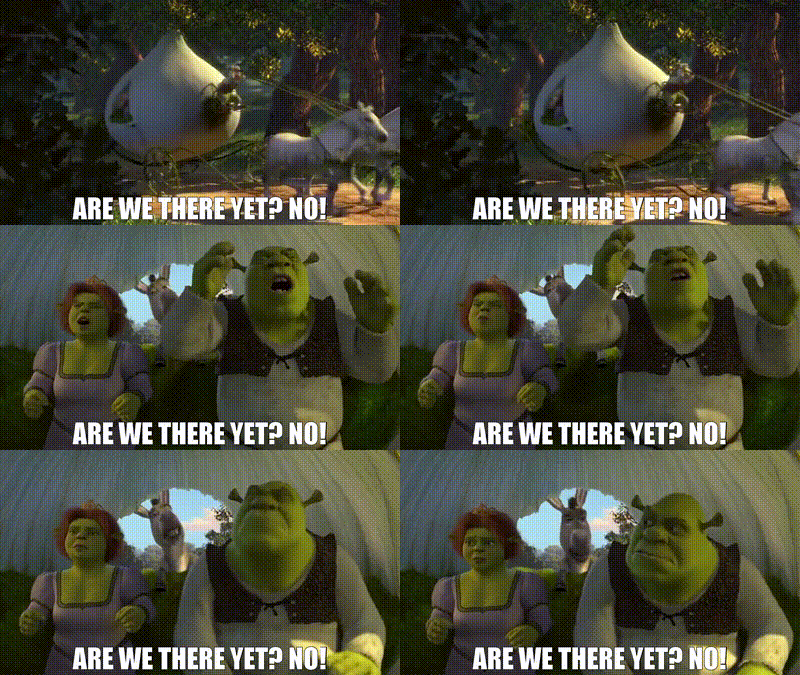
Here’s an exercise. Find a book you really like. Done? Good, now open it and read just one chapter. You just made more headway into that book than by merely trying to read ten pages. Just focus on the one chapter. Just one chapter, but I bet you are already craving the next one. You’re not focused so much in how many pages you need until you are finished with the book, but rather in when can I read the next chapter. You’re enjoying the ride, and not asking like Shrek’s Donkey over and over again how long do you need to get to Far Far Away.
MAKE A PUBLIC COMMITMENT.
You got to do anything and everything on your power to keep yourself accountable. This means setting clear goals, creating a detailed plan of action, and regularly reviewing your progress. Surrounding yourself with a supportive community or finding an accountability partner can provide the extra motivation and support needed to stay on track. For example, joining a book club not only allows you to engage with fellow book lovers but also provides a structured environment for discussing and analyzing the books you read, thereby deepening your understanding and commitment to your reading goals. Additionally, making plans to read a certain book with a friend not only adds a social element to your reading journey but also creates a sense of shared responsibility toward completing the book. Utilizing platforms like Goodreads where your reading history is left completely open to your friends and even to strangers enables you to not only track your reading progress but also to seek and provide recommendations, share thoughts on books, and participate in reading challenges, thus fostering a sense of accountability and camaraderie within the literary community. These are all great ways to engage in the community and stay accountable, ensuring that you remain focused and motivated in achieving your reading goals.
LEARN WHEN TO CALL IT QUITS.
In the name of all that’s holy, and I cannot stress this enough, IF YOU DON’T LIKE IT, PUT IT DOWN. There is nothing worse to hinder your progress and to ruin your motivation than to not know when to close one book and move on to the next. Sometimes, we feel an obligation to finish every book we start, but the truth is, life is too short to spend time on books that don’t resonate with us. Each book is an opportunity for growth and enjoyment, so if one doesn’t capture your interest, don’t be afraid to set it aside and find something that truly captivates you. This way, you can fully immerse yourself in the stories and knowledge that truly speak to you and whose lessons resonate with you. There are going to be tons of books you aren’t going to finish, and that is okay. The more you read, the more you are going to learn to distinguish what you enjoy and what makes you uncomfortable. Just give it time.
LOSE THE FEAR OF CRACKING THE SPINE.
It is an irrational fear. God knows I’ve kept countless books on my shelves without reading for the fear of cracking the spine. It is one of my two irrational fears, the other being that of the blank page. But as a reader, there is nothing worse than the fear of cracking the spine. A reader who fears to crack the spine is a reader who seldom immerses in the material he/she is reading. A reader who doesn’t crack the spine is also a reader who hates marking his/her books. Not marking one’s books means barely scratching the surface.
Marginalia are any kind of writing that is done along the margins of a book. These include annotations, inscriptions, and notes, and they serve the purpose of helping us understand the text. The oldest case of marginalia in books dates back to ancient civilizations such as Egypt and Mesopotamia. Archeologists have recorded fragments of clay tablets with writing down their margins. In Egypt, where papyri were used instead of clay tablets, annotations were made by students as a form of understanding the text. In classical antiquity it is not uncommon to find annotators among their most esteemed teachers. The great Cicero himself, for example, was known to be a prolific annotator, a practice that was common only among the elite and most educated of society.
Whether you choose to annotate your books or not, that is up to you, but here is a friendly reminder: the content of the book, its essence, won’t change just because you added a few pencil marks here and there. Just make sure that it has a purpose for you at the time you happen to be reading the book.
I annotate my books. I use pencil and paper page flags. I mark in essence anything that is meaningful to help me learn the craft of writing. I am a writer, and as such I take reading as a lesson in writing. I mark character names and development, well written sentences and well-formed dialogues. I take in the diction and syntax, circle words I do not know to look them up later using a dictionary or by merely using context clues. Believe me, I would make any middle school English teacher very proud. Unlike many bookworms I do not have a system. I don’t go by colors or symbols, but there’s a method to my madness.
Now, I’m not suggesting you handle your books like your last ex handled your poor heart—tread lightly! But let’s be reasonable here. Treat books for what they are: vessels of knowledge, not priceless art pieces to be locked away in a museum. There’s no need to go all WWE on your books either. After all, the fact that you can read them shows you’ve evolved beyond caveman status. So, no, no need for Stone Age handling techniques, unless you’re writing a history of wrestling in prehistoric times.

PROGRESS OVER PERFECTION
Perhaps the most important thing I learned was to aim for progress over perfection. Embracing this mindset has allowed me to take on new challenges with confidence, knowing that small steps forward are more valuable than waiting for flawless execution. Reading should be an enjoyable process, that delicious moment in the day where you get to unwind and escape from the tedium of daily life.
There was a period of my life where I wasn’t able to enjoy what I was reading because I was too worried about how long I was taking to read a particular book or that I wasn’t reading enough. But the truth is none of it really matters. Nobody cares about how many books you read in a year and how quickly you inhale a book. No one comes up to you and wonders how many books are you reading. Nobody cares and neither should you. Reading is not about numbers, it’s not about notches under your belt. Reading is about being in the moment, enjoying the now.
It has taken me a little while, but I have learnt to slow down. There are books you can inhale, but others aren’t meant to be consumed in a single sitting. There are books out there so small that you can probably read them in a matter of hours, but you’d be missing the point. Some books are meant to be read slowly, taken in slowly and broken down into minutiae. Some books you can’t put a time limit to. Such is the nature of reading.


Leave a Reply